Benefits to National Regulatory Authorities (NRAs)
VMRA-SAT evaluates regulatory maturity, identifies gaps and builds the evidence base for targeted investment and reform.
Veterinary medicines regulation
Veterinary medicines regulatory systems vary widely across countries in terms of scope, maturity, resources and division of responsibilities between various national bodies. In many countries, the regulatory mandate has expanded over time without a corresponding strengthening of institutional capacity, workforce skills or system-wide oversight. As a result, responsible authorities can struggle to clearly understand how well their regulatory systems are functioning or where the most critical weaknesses lie.


A lack of practical diagnostic tools
Many regulators lack a structured and practical method for assessing regulatory performance across all core functions. Existing assessments may be partial, focused on individual activities or driven by external requirements rather than internal learning. This makes it difficult to identify systemic issues, prioritise reforms or track progress over time. Without a clear diagnostic framework, efforts to strengthen regulation risk being fragmented, reactive or misaligned with actual needs.
From diagnosis to action
VMRA-SAT was developed to address these challenges by providing a structured, transparent and practical means for regulators to assess their own systems. It fills an important gap by focusing specifically on veterinary medicines regulation, complementing broader assessments of veterinary services and legislative frameworks while providing function-level detail that supports targeted, evidence-based strengthening.
The outputs generated through VMRA-SAT provide a strong foundation for prioritised improvement planning. Rather than attempting to reform all areas at once, regulators can use assessment results to identify high-impact actions and sequence reforms in a realistic and manageable way. This supports more effective use of limited resources and helps ensure that reforms are grounded in evidence rather than assumptions.
VMRA-SAT also supports external engagement. Assessment results, when shared at the discretion of the country, can help structure dialogue with government decision-makers, development partners and regional peers. The tool provides a common language for discussing regulatory maturity and capacity, reducing ambiguity and facilitating more productive conversations about support, investment and collaboration.
By offering a consistent and transparent framework, VMRA-SAT also supports longer-term tracking of progress. Repeat assessments allow authorities to monitor improvements over time, demonstrate results and reinforce a culture of continuous improvement. In this way, VMRA-SAT serves not only as a snapshot of current capacity, but as a practical instrument for sustained regulatory strengthening.

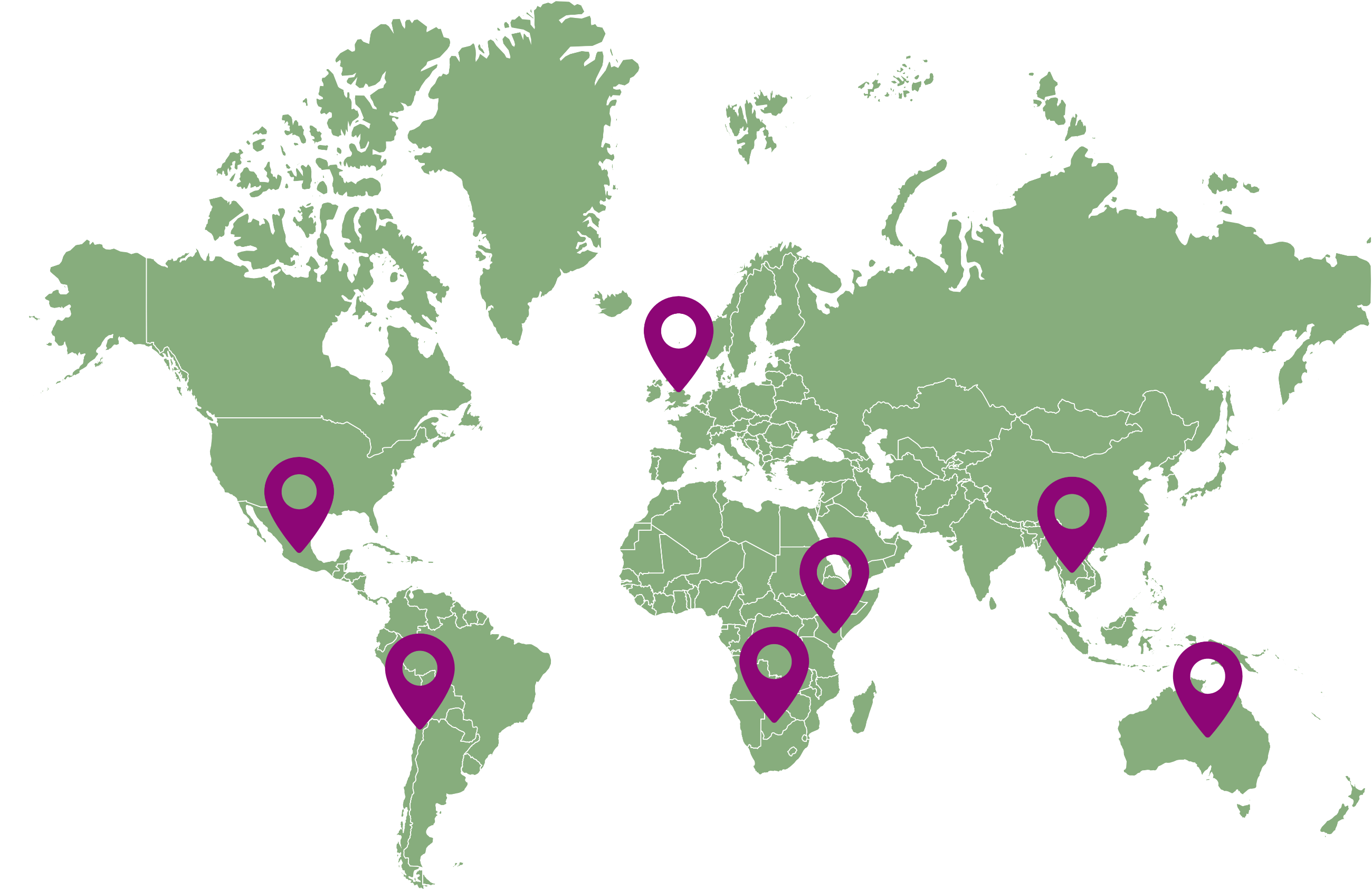
Tried and tested globally
Piloted in 11 countries across four WOAH regions
Africa: Rwanda, Botswana, Kenya, Tanzania, Uganda, Zambia
Americas: Mexico, Chile
Asia-Pacific: Australia, Thailand
Europe: United Kingdom
Pilot country experience
Pilot and partner countries described VMRA-SAT as a practical, structured and evidence-based tool that helps authorities understand their current capacity, identify gaps, prioritise improvements and develop concrete plans to strengthen veterinary medicines regulation.
Quotes from regulators who piloted the tool
“A robust, practical and high-impact tool for strengthening veterinary medicines regulatory systems.”
Veterinary Medicines Directorate, Kenya
“The tool helped us turn identified gaps into practical development plans.”
Botswana Medicines Regulatory Authority, Botswana
“VMRA-SAT supports self-reflection, learning and continuous improvement.”
Rwanda Food and Drugs Authority, Rwanda
“VMRA-SAT enabled institutional strengthening and helped align our regulatory system with international standards.”
SENASICA, Mexico
“A structured framework for identifying gaps and opportunities to strengthen veterinary medicines regulation.”
Tanzania Medicines and Medical Devices Authority, Tanzania
“A simple yet powerful tool that helps countries strengthen their veterinary medicines regulatory systems.”
ANSES-ANMV, France (WOAH Collaborating Centre)
Are you ready to start your self-assessment?
VMRA-SAT can be used by veterinary medicines regulatory authorities to conduct a structured self-assessment using one of two available formats.
- Authorities seeking a comprehensive, in-depth assessment across all functions, indicators and sub-indicators should use the Full Version (Desktop). Access to the software and country data file can be requested by completing the online request form.
- Authorities wishing to carry out an initial or preparatory assessment can use the Lite Web Version (WebApp), which provides a streamlined entry point and can be accessed directly by clicking the link to the online platform.
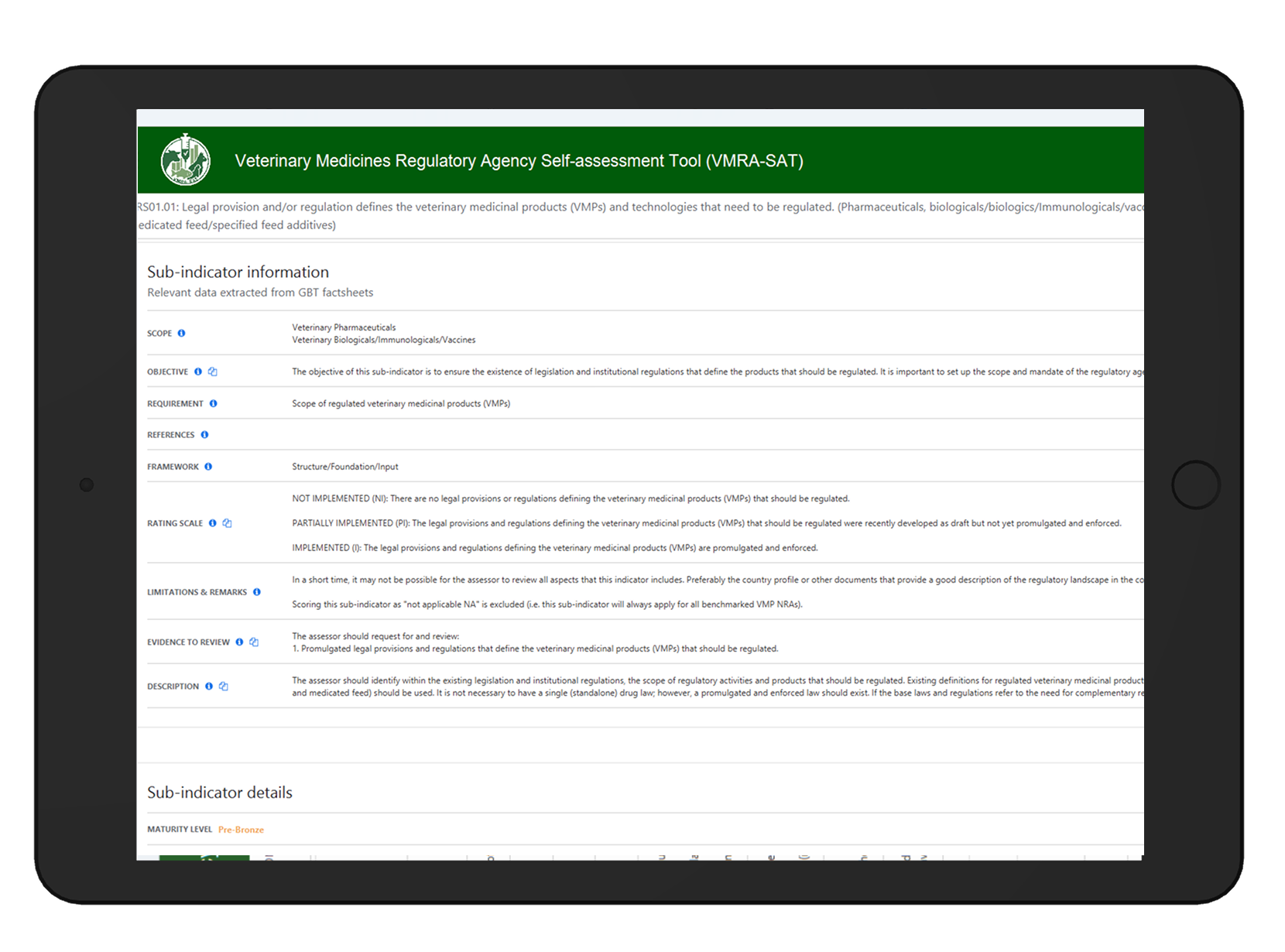
Getting started with the full version of VMRA-SAT
Once the request is made, you will receive an email with a link to download the software and your country’s data file. Links to instructions on how to download and install the software (both Windows and macOS) will also be included. Please ensure that you have the necessary permissions to download and install the software from your institution.
Please follow the installation instructions carefully and follow the guidance on how to upload your country’s data file.
Once you have installed and uploaded the data file successfully, please go to the training page and complete the training provided. It is in your interest to undertake the training before starting to use VMRA-SAT.
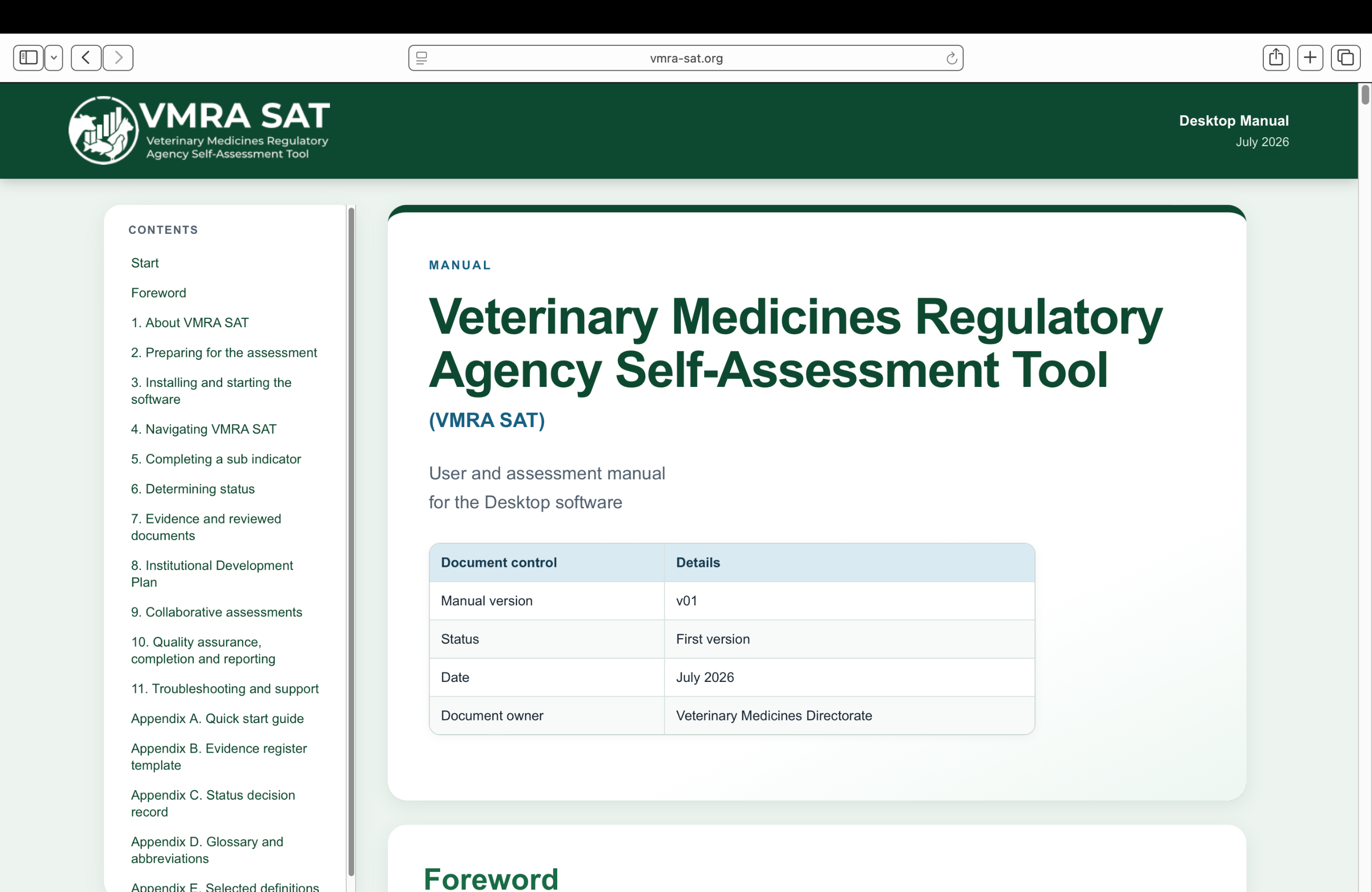
The VMRA-SAT Manual takes you through the desktop VMRA-SAT and introduces you to the main features. After familiarising yourself with the tool, please undertake the training as it covers all aspects of using VMRA-SAT.
FAQs
VMRA-SAT is a structured, globally applicable, country-owned and voluntary self-assessment tool designed specifically for authorities responsible for regulating veterinary medicinal products. It helps authorities evaluate the maturity and implementation of their veterinary medicines regulatory systems through a self-led, evidence-based process, identify strengths and gaps, agree priorities and support institutional development planning.
The tool helps authorities assess what regulation is already in place, where the main gaps are and what actions may be needed to strengthen the system over time. It provides a structured basis for reflection, priority setting and institutional development planning.
Pilot feedback shows that the tool is valued for helping authorities identify practical improvement actions, support honest self-reflection and provide a clearer basis for planning future development. Users also saw value in the potential for benchmarking and shared learning in the future.
The tool can support regulatory system strengthening by helping authorities make sense of complex systems in a structured way. It can inform institutional development plans, support governance discussions, guide prioritisation and help authorities present a clearer case for reform and investment.
Some authorities may find a full self-assessment difficult if their systems are still at an early stage, or if staffing, resources, time or documentation are limited. In these contexts, the tool can still be useful as a reference point or checklist. In response to pilot feedback, a Lite Web Version (WebApp) has been created as a lighter and more accessible starting point.
The tool assesses eight core regulatory functions: national regulatory system governance; registration and marketing authorisation; pharmacovigilance; market surveillance and control; licensing of establishments; regulatory inspection; laboratory testing; and batch release of biological products. These functions are supported by 13 indicator areas and 235 sub-indicators.
Yes. Pilot feedback highlights the importance of involving the right people across relevant functions and having enough internal coordination to gather evidence, review findings and agree priorities. Feedback also points to the value of engaging senior leadership in reviewing the outcomes.
The assessment produces a detailed maturity profile across all eight functions, identifying strengths and areas for improvement. Countries are encouraged to use this to develop an institutional development plan (IDP) that prioritises actions, sets timelines and supports resource mobilisation. The tool can be repeated periodically to track progress.
The Full Version (Desktop) tool can require a significant investment of time, staff and supporting evidence, as highlighted during piloting. However, this reflects the depth and value of the assessment. It provides authorities with a comprehensive and evidence-based understanding of their regulatory system, helping them identify strengths and gaps, prioritise improvements, support resource planning and monitor progress over time. For authorities that are not yet ready to undertake the full assessment because of staffing, time, resource or documentation constraints, the Lite Web Version (WebApp) provides a practical starting point.
Visit the VMRA-SAT website at www.vmra-sat.org or contact the project team at info@vmra-sat.org.